Best Seller Icon Bestseller

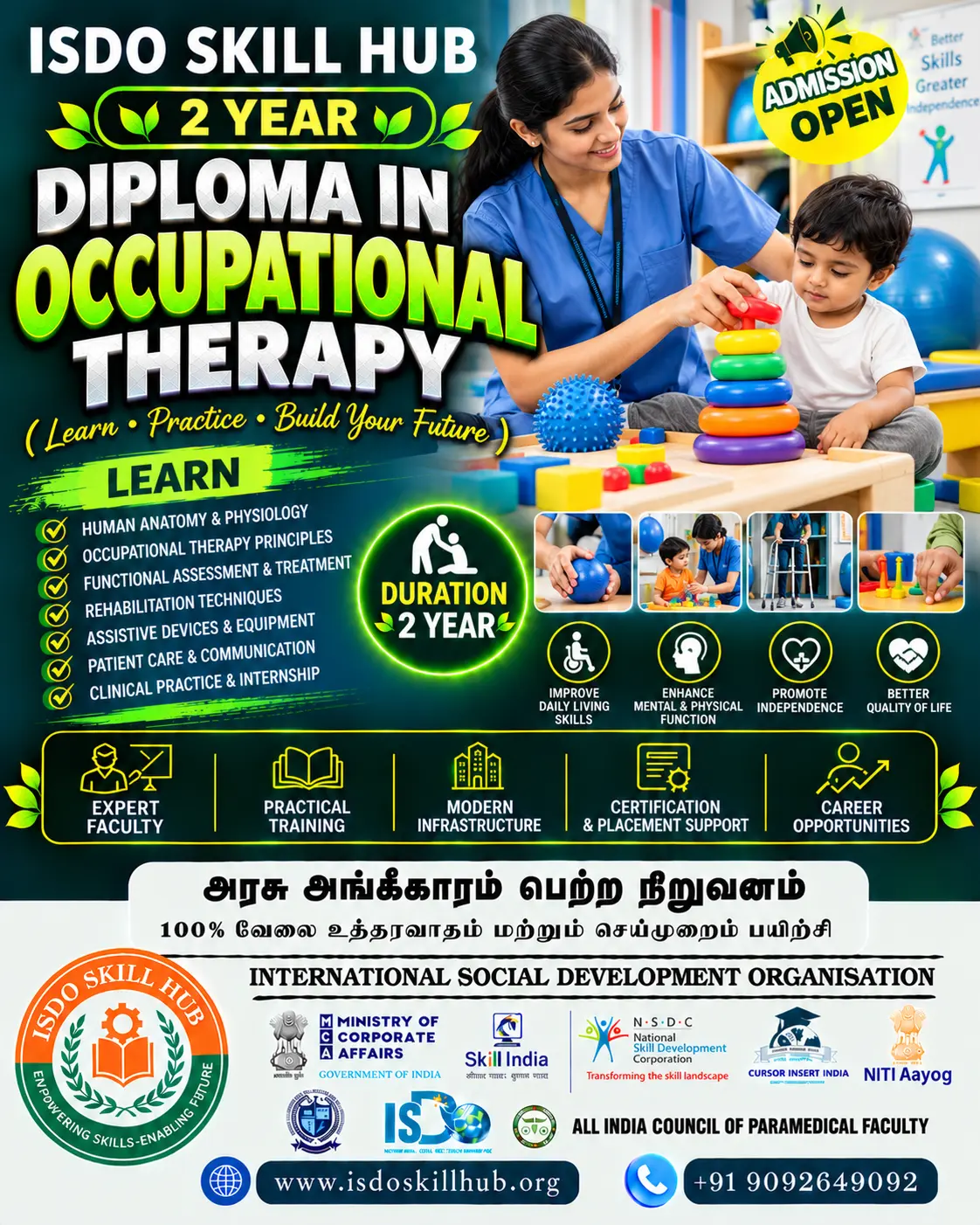
DIPLOMA In OCCUPATIONAL THERAPY(S-DOT-1551)

  • Last updated Sep, 2026
  • Certified Course
₹28,000 ₹35,000

Course Includes

  • Duration2 Years
  • Enrolled0
  • Lectures730
  • Videos0
  • Notes0
  • CertificateYes

What you'll learn

Develop essential knowledge and practical skills in occupational therapy and rehabilitation support. This diploma course covers human anatomy and physiology, therapeutic activities, functional assessment, rehabilitation techniques, mobility and daily living skills, assistive devices, patient care, occupational therapy practices and professional healthcare procedures through structured theory and hands-on practical training.

Show More

Course Syllabus

Diploma in Occupational Therapy


Unit 1: Fundamentals of Occupational Therapy & Human Anatomy

Theory

  • Introduction to Occupational Therapy
  • History, principles and scope of Occupational Therapy
  • Role and responsibilities of an Occupational Therapy professional
  • Human anatomy and physiology
  • Musculoskeletal, nervous and cardiovascular systems
  • Basic medical terminology
  • Professional ethics and patient confidentiality

Practical

  • Identification of major bones, muscles and joints
  • Basic anatomical demonstrations
  • Observation of posture and movement
  • Patient communication and professional behaviour
  • Basic documentation and record keeping

Unit 2: Physiology, Kinesiology & Functional Movement

Theory

  • Fundamentals of human physiology
  • Kinesiology and biomechanics
  • Joint movements and range of motion
  • Muscle function and strength
  • Posture and body mechanics
  • Principles of functional movement
  • Basic principles of ergonomics

Practical

  • Range-of-motion observation
  • Basic muscle strength assessment under supervision
  • Posture assessment
  • Functional movement observation
  • Body mechanics and safe transfer techniques
  • Basic activity analysis

Unit 3: Occupational Therapy Assessment & Evaluation

Theory

  • Principles of occupational therapy assessment
  • Patient history and occupational profile
  • Functional assessment
  • Activities of Daily Living (ADL)
  • Instrumental Activities of Daily Living (IADL)
  • Basic cognitive and motor assessment
  • Documentation and goal setting

Practical

  • Taking a basic occupational profile
  • Observation of functional activities
  • ADL assessment practice
  • Basic range-of-motion and functional assessment
  • Activity analysis
  • Preparation of assessment records

Unit 4: Therapeutic Activities & Exercise

Theory

  • Principles of therapeutic activities
  • Activity grading and adaptation
  • Exercise principles in occupational therapy
  • Strength, flexibility and coordination activities
  • Fine and gross motor activities
  • Hand function and dexterity
  • Therapeutic use of meaningful activities

Practical

  • Fine-motor activities
  • Hand coordination exercises
  • Gross-motor activities
  • Strengthening and flexibility activities
  • Dexterity exercises
  • Activity grading and modification
  • Designing simple therapeutic activity programmes

Unit 5: Neurological Occupational Therapy

Theory

  • Introduction to the nervous system
  • Common neurological conditions and functional limitations
  • Principles of neurological rehabilitation
  • Motor control and coordination
  • Balance and functional mobility
  • Cognitive and perceptual functions
  • Occupational therapy approaches in neurological rehabilitation

Practical

  • Functional movement observation
  • Balance and coordination activities
  • Fine-motor training
  • Cognitive and perceptual activities
  • ADL training approaches
  • Development of supervised rehabilitation activities

Unit 6: Orthopedic & Musculoskeletal Occupational Therapy

Theory

  • Musculoskeletal conditions and functional limitations
  • Basic orthopedic rehabilitation principles
  • Joint and muscle injuries
  • Fracture rehabilitation concepts
  • Arthritis and mobility limitations
  • Hand and upper-limb rehabilitation
  • Pain and activity-management principles

Practical

  • Functional assessment of upper limbs
  • Range-of-motion exercises
  • Hand function activities
  • Strength and coordination exercises
  • ADL adaptation
  • Splinting awareness and supervised practice
  • Activity modification techniques

Unit 7: Pediatric & Geriatric Occupational Therapy

Theory

  • Introduction to pediatric occupational therapy
  • Child development and developmental milestones
  • Sensory and motor development
  • Learning and functional difficulties
  • Introduction to geriatric occupational therapy
  • Age-related functional changes
  • Fall prevention and independence in daily activities

Practical

  • Age-appropriate play activities
  • Fine and gross motor activities for children
  • Sensory-based activity awareness
  • Functional activities for older adults
  • Balance and mobility activities
  • ADL training and environmental modification

Unit 8: Mental Health & Psychosocial Occupational Therapy

Theory

  • Introduction to mental health occupational therapy
  • Psychosocial aspects of occupation
  • Occupational balance and routine
  • Therapeutic activities for mental wellness
  • Group activities and social participation
  • Stress-management and relaxation activities
  • Professional boundaries and referral awareness

Practical

  • Structured therapeutic activities
  • Creative and recreational activities
  • Group activity planning
  • Social participation activities
  • Relaxation and mindfulness-based wellness activities
  • Activity scheduling and routine planning

Unit 9: Assistive Devices, Rehabilitation & Professional Practice

Theory

  • Introduction to assistive technology
  • Mobility and self-care aids
  • Adaptive equipment
  • Environmental modification
  • Accessibility and safety
  • Rehabilitation team and multidisciplinary care
  • Patient education and caregiver support
  • Professional ethics and documentation

Practical

  • Identification of assistive devices
  • Demonstration of safe use of selected aids
  • ADL adaptation
  • Home and workplace accessibility assessment
  • Basic caregiver education
  • Rehabilitation programme documentation
  • Team-based case discussion

Unit 10: Integrated Occupational Therapy Practicum

Theory

  • Complete occupational therapy workflow
  • Patient assessment and goal setting
  • Treatment/activity planning
  • Functional rehabilitation
  • Progress monitoring and documentation
  • Patient and caregiver communication
  • Professional responsibilities and clinical safety

Practical

  • Supervised patient assessment
  • Occupational profile preparation
  • Functional and ADL assessment
  • Therapeutic activity planning
  • Individualized activity sessions under supervision
  • Progress documentation
  • Patient/caregiver education
  • Clinical observation and supervised practicum
  • Case presentation and viva

Final Project

Occupational Therapy Assessment & Functional Rehabilitation Project

Students complete a supervised case-based project involving:

  1. Selection of an approved case
  2. Patient/occupational profile
  3. Relevant medical and functional history
  4. Basic functional assessment
  5. ADL/IADL assessment
  6. Identification of occupational performance difficulties
  7. Goal-setting
  8. Activity analysis
  9. Development of a supervised occupational therapy activity programme
  10. Selection/adaptation of therapeutic activities
  11. Assistive-device or environmental-modification recommendations where appropriate
  12. Progress documentation
  13. Patient/caregiver education component
  14. Final case report
  15. Practical demonstration
  16. Presentation and viva


Eligibility

Who can apply for this course

12th Pass

Course Fees

Course Fees
:
₹35000/-
Discounted Fees
:
₹ 28000/-
Course Duration
:
2 Years

Review

0.0
Course Rating (0 reviews)
0%
0%
0%
0%
0%


Call
Text Message
Review
Brochure
Email
CHAT